Hot Water Troubleshooter Quiz
Find out why your hot water stopped working and what to do next. This tool guides you through common issues based on your water heater type and symptoms.
1
What type of water heater do you have?
2
What's happening with your hot water?
Your Solution
Important Safety Notes
Never work on electrical or gas systems if you smell gas or see sparks.
If your hot water has suddenly disappeared, you’re not alone. It’s a problem that hits hard in Brisbane, especially when the mornings are cool and you’re standing under a cold shower wondering what went wrong. The good news? Most of the time, it’s not a full system failure. It’s something simple you can check yourself before calling a plumber.
Is the power on?
If you have an electric water heater, the first thing to check is whether it’s getting power. Look at your switchboard. Is the circuit breaker for the water heater tripped? It’s usually labeled "Hot Water" or "EWH." If it’s in the middle or off position, flip it back on. Sometimes, a power surge or an overloaded circuit will trip it. If it trips again right away, don’t keep resetting it - there’s a fault deeper in the system.
Also, check if your timer is working. Many electric water heaters in Australia have a timer that only heats water during off-peak hours. If the timer’s battery is dead or it’s set incorrectly, your water might only heat up at night. Check the display or dial. If it’s blank or stuck on "Off," you may need to reset it or replace the timer unit.
What about the thermostat?
A faulty thermostat is one of the most common reasons for no hot water. The thermostat controls the temperature and turns the heating element on and off. If it’s stuck, your heater might think the water is already hot when it’s not.
For electric tanks, you’ll find the thermostat behind an access panel on the side of the tank. Turn off the power first. Then, use a multimeter to test for continuity. If there’s no reading, the thermostat is dead. Replacement thermostats cost around $40-$70 and are easy to swap if you’re comfortable with basic tools. If you’re not, call a licensed electrician. Working with live wires is dangerous.
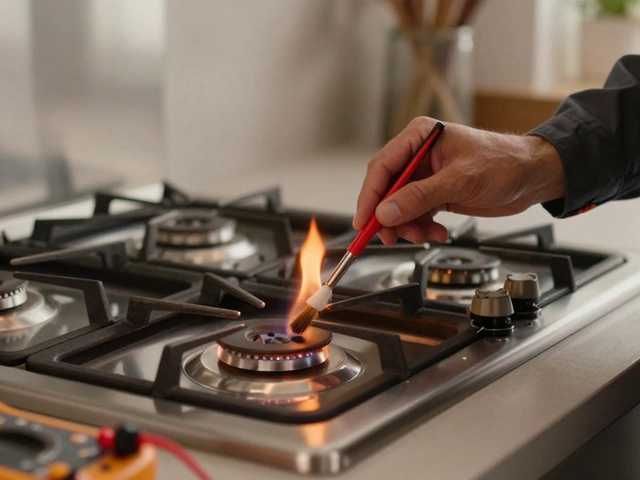
Gas water heaters have a different setup. Their thermostat is usually on the front of the gas control valve. If the pilot light went out, the whole system shuts down. Check if the flame is lit. If not, follow the relighting instructions on the tank. If the pilot won’t stay lit, the thermocouple might be faulty. That’s a $25 part you can replace yourself - it’s just a small metal rod that senses heat and tells the gas valve to stay open.
Is the heating element broken?
Electric water heaters have one or two heating elements inside the tank. If one fails, you might get lukewarm water. If both go, you get nothing. The lower element usually fails first because it’s constantly submerged and works harder.
To test it, turn off the power and drain a few liters of water from the tank. Remove the access panel and the insulation to expose the element. Use a multimeter to check resistance. A good element reads between 10 and 30 ohms. If it shows infinite resistance (OL), it’s dead. Replacing it takes about an hour. You’ll need a new element (around $60-$100), a wrench, and a little patience. Make sure the tank is fully drained before you start.

Could it be the dip tube?
The dip tube is a long plastic pipe that sends cold water to the bottom of the tank. Over time, especially in older units, it can crack or dissolve. When that happens, cold water mixes with hot water right at the top, making your shower feel lukewarm even when the tank is full.
This is more common in heaters older than 10 years. Signs include sudden drops in hot water volume and cloudy or white particles in your taps. If you suspect the dip tube, it’s usually cheaper to replace the whole tank than to try and swap the tube - it’s buried deep inside the tank and hard to access without draining and disassembling everything.
Is your tank leaking?
If you’ve noticed puddles under your water heater, that’s a red flag. Water heaters last about 8-12 years. If yours is older and leaking, it’s not worth repairing. The tank has corroded from the inside, and even if you fix one leak, another will pop up soon.
Check the pressure relief valve too. It’s the pipe sticking out the side near the top. If it’s dripping constantly, the pressure inside the tank is too high. That can be caused by a faulty thermostat or a blocked expansion tank. But if the tank itself is leaking from the bottom, it’s time for a new one. No patch job will hold.
Gas heater issues: pilot light, gas supply, or venting
If you have a gas water heater and no hot water, start with the pilot light. If it’s out, relight it using the instructions on the unit. If it goes out again, the thermocouple is likely the culprit. It’s a safety device that cuts gas if the flame isn’t detected. Replace it for under $30.
Also, check your gas supply. Is the gas valve turned on? Is your gas meter working? If other gas appliances like your stove or fireplace aren’t working either, the issue might be with your gas provider. Call them before you call a plumber.
Another hidden issue is blocked flue vents. If the exhaust pipe is clogged with bird nests, leaves, or soot, the heater can shut down automatically for safety. Check the top of the unit where the vent exits. If it’s blocked, clean it out or get a professional to do it. A blocked vent can also cause carbon monoxide buildup - a serious risk.

Water pressure or flow problems
Sometimes, it’s not the heater - it’s the pipes. If your cold water pressure is fine but hot water barely trickles out, you might have a clogged aerator on your showerhead or faucet. Remove it and soak it in vinegar for an hour. Mineral buildup from hard water is common in Brisbane and can block flow.
Also, check if the hot water outlet valve on the tank is fully open. It’s usually a small handle on the pipe coming out of the top of the heater. If it’s partially closed, you’ll get low flow. Make sure it’s turned all the way counterclockwise.
When should you call a professional?
You can fix most of these issues yourself - if you’re comfortable with basic tools and safety rules. But call a licensed plumber or electrician if:
- The circuit breaker keeps tripping
- You smell gas or notice a hissing sound
- The tank is leaking from the bottom
- You’re unsure about working with electricity or gas
- Your heater is over 10 years old and needs multiple repairs
Replacing a water heater in Brisbane costs between $1,200 and $2,500 depending on size, type, and installation. But if you wait too long, a burst tank can flood your home and cost thousands more in damage.
Prevent future problems
Here’s how to avoid another cold shower:
- Flush your tank every 12 months to remove sediment - it builds up and reduces efficiency.
- Set your thermostat to 60°C. That’s hot enough to kill bacteria but not so hot it scalds or wastes energy.
- Install a water softener if you have hard water. It cuts down on mineral buildup.
- Check your pressure relief valve every six months by lifting the lever briefly. Water should flow out. If it doesn’t, replace it.
- Replace your anode rod every 3-5 years. It protects the tank from corrosion. Most people forget about it - but it’s the #1 reason tanks last longer.
Hot water isn’t a luxury in Brisbane. It’s part of daily life. When it goes off, it’s frustrating - but rarely a disaster. Most of the time, you can fix it yourself in under an hour. Just take your time, stay safe, and don’t ignore the small signs. A dripping valve or a flickering pilot light today could save you a full replacement tomorrow.
Why is my hot water suddenly cold?
Your hot water suddenly going cold usually means the heating system stopped working. Common causes include a tripped circuit breaker, a blown heating element, a faulty thermostat, or a pilot light that went out on gas heaters. Check the power first, then the thermostat or pilot light. If those are fine, the issue might be sediment buildup or a failed dip tube.
How do I know if my water heater is broken or just needs resetting?
If your water heater has a reset button (usually red and located near the thermostat), press it once. If the water heats up after that, it was just a temporary overload. If it trips again, or if there’s no reset button and the water stays cold, the problem is deeper - like a failed element, thermostat, or gas valve. Resetting won’t fix worn-out parts.
Can a water heater explode if it’s not maintained?
It’s extremely rare, but possible. Water heaters have a pressure relief valve to prevent overpressure. If that valve is blocked or broken, and the thermostat fails to shut off, pressure can build up inside the tank. Modern tanks are built to handle high pressure, but if corrosion weakens the tank and pressure rises too much, rupture can happen. Regular maintenance - especially checking the relief valve and flushing sediment - prevents this.
How long does a water heater last in Brisbane?
Most water heaters last between 8 and 12 years in Brisbane. Hard water and high usage shorten their life. Tanks with replaceable anode rods last longer - up to 15 years - if you replace the rod every 3-5 years. If your heater is over 10 years old and starting to have problems, it’s often more cost-effective to replace it than to keep repairing it.
Should I switch from electric to gas or heat pump?
Electric water heaters are common in Brisbane, but they’re expensive to run. Gas heaters are cheaper to operate but need a gas line. Heat pumps are the most efficient - they use electricity to move heat from the air, not generate it directly. They can cut your hot water bill by up to 70%. If you’re replacing your heater, a heat pump is often the best long-term choice, especially with rebates available in Queensland.