Extractor Fan Sizing Calculator
Enter your room details below to determine the correct airflow capacity (CFM) and fan type needed to prevent mold and odors.
Enter measurements to see recommendations
You’ve got a foggy mirror every morning and that lingering smell of damp laundry in your hallway. You know you need an extractor fan or a replacement for the noisy, ineffective one currently rattling in your ceiling. But walking into a hardware store can feel like entering a maze of specs that mean nothing to most people. Is 100 CFM enough? Do you need inline ducting? What does "sone" actually measure?
Here is the blunt truth: buying the wrong extractor fan is worse than having none at all. An undersized unit won’t clear moisture, leading to mold growth on your grout and paint. An oversized, poorly installed unit might suck out all your heated air in winter or sound like a jet engine taking off. The goal isn't just to buy a fan; it’s to match airflow capacity to room volume and resistance.
The Golden Rule: Match Airflow to Room Volume
Most homeowners guess based on the physical size of the hole in their ceiling. That’s a mistake. You need to calculate the cubic feet per minute (CFM) required to exchange the air in your room effectively. In Australia and New Zealand, we often use liters per second (L/s), but many imported fans still list CFM. Let’s stick to the universal logic first.
For bathrooms, the standard recommendation is to change the air 8 to 10 times per hour. For kitchens, because of grease and heavy cooking odors, you want closer to 15 to 20 exchanges per hour. Here is how you do the math without pulling out a calculator app:
- Measure your room: Length × Width × Height = Cubic Feet.
- Calculate basic CFM: Divide the total cubic feet by 60 (minutes in an hour) to get the volume per minute.
- Apply the multiplier: Multiply that number by 8 (bathroom) or 15 (kitchen).
Let’s look at a real-world example. Say you have a small ensuite bathroom that is 2 meters long, 1.5 meters wide, and has a 2.4-meter high ceiling. Convert to feet roughly (or use metric equivalents if buying local AU/NZ models): This room needs about 50-60 CFM. If you install a 35 CFM fan, you will still see condensation on the mirror ten minutes after showering. If you install a 150 CFM fan, you’ll waste energy and create negative pressure issues unless properly balanced.
Understanding Static Pressure: The Hidden Killer
This is where most DIY buyers fail. Manufacturers test fans under ideal conditions-short duct runs, no bends, no filters. Your house is not ideal. Every foot of ducting, every elbow bend, and every grille adds resistance, known as static pressure.
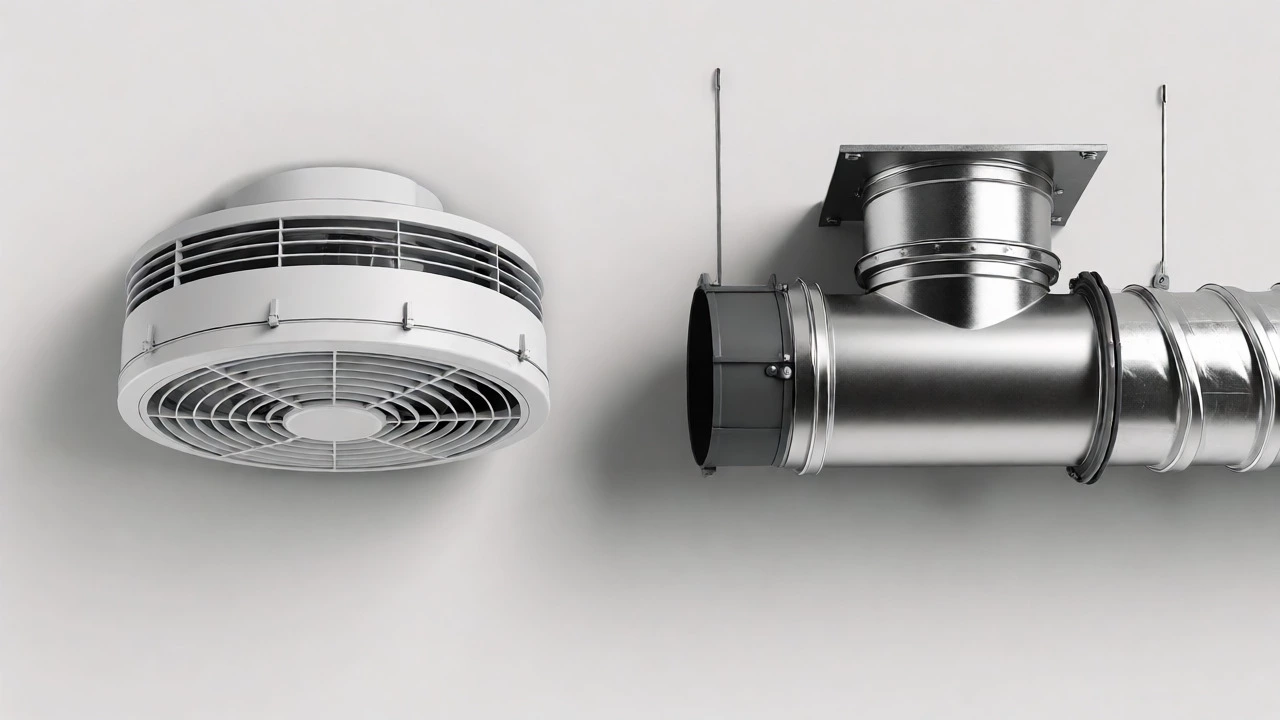
If your fan exhausts directly through the wall or roof with less than 3 meters of straight ducting, a standard axial fan works fine. These are the cheap, flat units you see in big-box stores. They push air forward efficiently when there is little resistance.
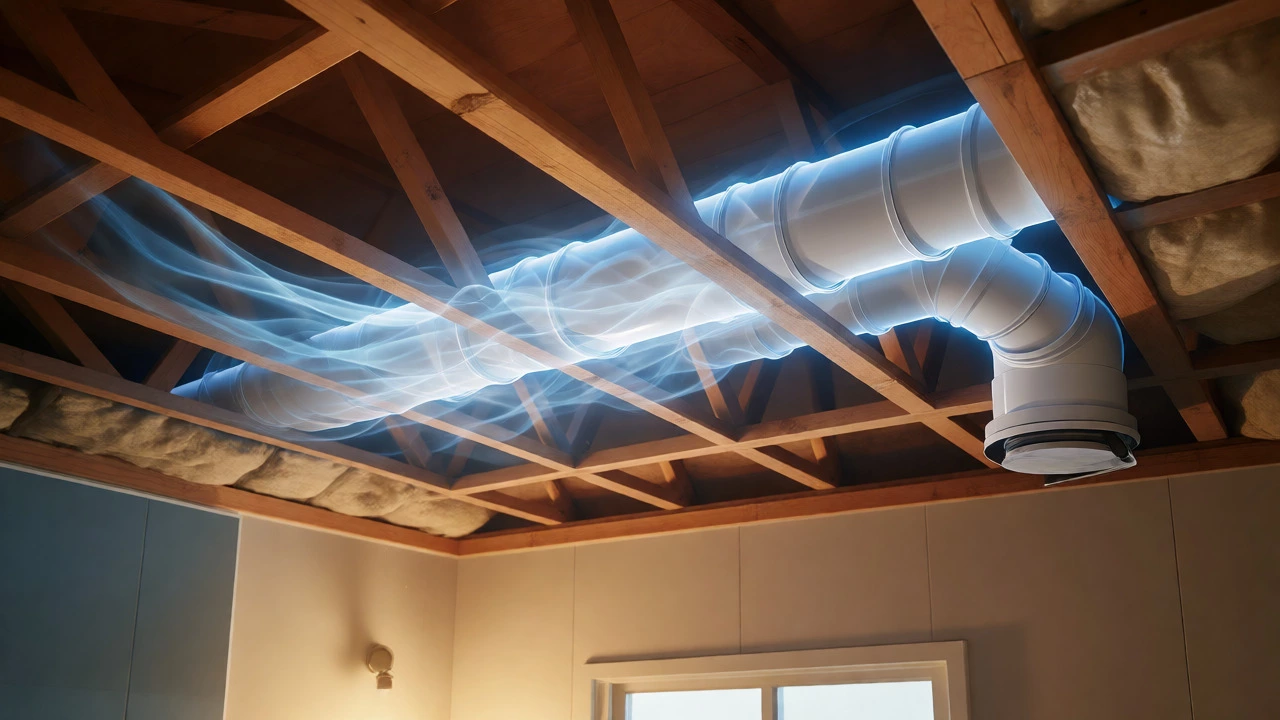
But what if your bathroom is in the middle of the house? Or your kitchen range hood needs to vent through two 90-degree elbows and 6 meters of flexible foil ducting before reaching the eaves? An axial fan will choke. It will run loudly, vibrate, and barely move any air. You need a centrifugal fan (often called an inline fan). These fans are designed to generate higher static pressure, pushing air through long, restrictive duct runs.
| Fan Type | Best For | Duct Length Limit | Noise Level |
|---|---|---|---|
| Axial (Ceiling/Wall) | Short direct vents, small bathrooms | < 3 meters | Moderate |
| Centrifugal (Inline) | Long ducts, multiple bends, central homes | > 6 meters | Low (if mounted remotely) |
| Hood Integrated | Kitchens only | Varies by model | High (at max speed) |
Noise Matters: Decibels vs. Sones
Check the packaging for "Sones," not just Decibels (dB). Decibels measure sound intensity logarithmically, which doesn't always correlate with human annoyance. Sones measure perceived loudness linearly. One sone is quiet library noise. Four sones is normal conversation. Ten sones is a vacuum cleaner.
For a bathroom where you might be brushing your teeth or relaxing in a bath, aim for a fan rated at 1.5 sones or lower on low speed. Many modern fans have dual speeds. Use the high setting during showers for maximum extraction, then switch to low for continuous background ventilation. If you see a fan listed at 4.0 sones or higher, expect it to sound like a hairdryer. Unless you love white noise while sleeping, avoid it.
Ducting Size and Backdraft Dampers
Never reduce duct size. If your fan outlet is 150mm (6 inches), use 150mm ducting all the way to the outside. Reducing to 100mm increases velocity but also dramatically increases static pressure, choking the fan. Use rigid PVC pipe where possible instead of flexible foil ducting. Foil collapses easily, creating kinks that block airflow. Rigid pipe maintains its shape and offers less friction.
Also, check for a backdraft damper. This is a flap that closes when the fan is off. Without it, cold winter air, hot summer humidity, insects, and even possums can travel down the duct into your home. Some fans have built-in flaps; others require a separate wall cap with a gravity-operated shutter. Always install one.
Smart Features and Humidity Sensors
Do you really need a timer? Probably not. Most people forget to turn it off, wasting electricity, or turn it off too soon, leaving moisture behind. A better investment is a humidity sensor (hygrostat). These fans automatically activate when relative humidity exceeds a set point (usually 60-70%) and run until levels drop.
In Brisbane’s humid climate, this feature is invaluable. You don’t want to manually manage ventilation when the ambient humidity is already 80%. A sensor ensures the fan runs exactly as long as needed to prevent mold spores from settling. Look for models with adjustable sensitivity so you can tune them to your specific bathroom usage patterns.
Installation Pitfalls to Avoid
Even the best fan fails if installed poorly. Here are common mistakes I see regularly in repair calls:
- Venting into the roof space: Never do this. Moisture accumulates in insulation, causing sagging ceilings and rotting rafters. Always vent to the exterior.
- Using plastic screws for metal fans: Over time, heat and vibration loosen these. Use stainless steel screws and washers.
- Ignoring electrical load: If adding lights and heaters to the same circuit, ensure the wiring gauge handles the combined amperage. Older homes often have thin wiring.
- Tight sealing gaps: Seal the gap between the fan housing and the ceiling plasterboard with silicone. Unsealed gaps allow moist air to leak into the attic rather than being extracted.
Local Context: Australian Standards and Energy Efficiency
In Australia, compliance with AS/NZS standards is crucial. Ensure the fan is IP-rated appropriately for wet zones (Zone 0, 1, or 2 in bathrooms). Zone 0 is inside the shower/bath; Zone 1 is above it up to 2.25m; Zone 2 extends further. Fans in Zone 1 usually need IPX4 splash protection.
Energy efficiency matters too. Look for EC (Electronically Commutated) motor fans. They consume significantly less power than traditional AC motors and offer variable speed control. While they cost more upfront, the savings over five years in constant operation add up, especially if you run ventilation continuously for indoor air quality.
Can I replace my old extractor fan myself?
Yes, if you are comfortable working with electricity and ladders. Turn off the circuit breaker first. Most replacements involve unscrewing the old trim, disconnecting wires, removing the old motor/housing, and installing the new unit using the existing hole. However, if the ducting is damaged or the hole size differs, professional help is recommended.
How long should I run my extractor fan after showering?
Run it for at least 20 minutes after finishing. Moisture continues to evaporate from walls and floors after the water stops. If you have a humidity-sensing fan, it will handle this automatically. If manual, use a timer switch to ensure it doesn't get forgotten.
Why is my new extractor fan louder than the old one?
New fans often have higher RPMs to meet stricter efficiency standards. Also, if the old fan was clogged with dust, it moved less air quietly. Check for obstructions in the ducting. If the new fan is mounted loosely against drywall, vibrations amplify noise. Tighten mounting screws and consider adding rubber grommets.
Do I need a fan with a light?
Not necessarily. Combining functions saves space but complicates repairs. If the light bulb blows, you might lose ventilation access if the entire unit must be removed. Separate units offer flexibility and easier maintenance. Choose integrated units only if ceiling height or layout strictly limits options.
What is the difference between axial and centrifugal fans?
Axial fans blow air straight through, like a computer fan. They are efficient for short distances. Centrifugal fans spin air outward to build pressure, allowing them to push air through long ducts and around corners. Use axial for direct vents, centrifugal for complex ducting.