Nothing hits harder than stepping into the shower and getting ice-cold water instead of a nice hot stream. If your hot water heater suddenly stops working, it’s not just inconvenient-it’s a full-blown household emergency. You don’t need to panic, though. Most water heater failures have simple, fixable causes. Here’s what to check when your hot water heater stops working, step by step, based on real-world fixes seen in Brisbane homes.
1. Check the Power Supply
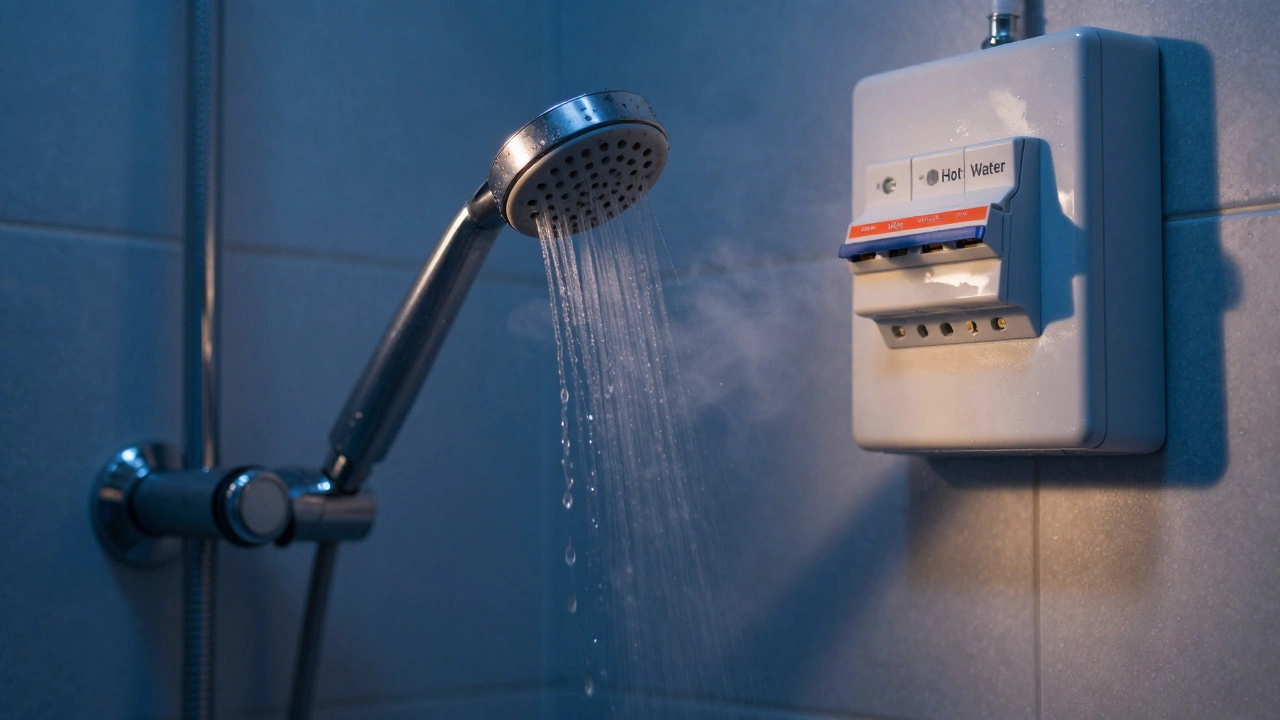
If you’ve got an electric water heater, the first thing to look at is the power. It sounds obvious, but a tripped circuit breaker is the #1 reason electric heaters go cold. Head to your switchboard and find the breaker labeled "Water Heater" or "Hot Water." If it’s flipped to the middle or off position, reset it. If it trips again immediately, something’s wrong inside the unit-don’t keep resetting it. That’s a sign of a short circuit or a bad heating element.
Also, check if the unit has a separate wall switch nearby. Some older installations have a manual cutoff switch near the heater. It’s easy to accidentally turn it off while cleaning or doing maintenance.
2. Inspect the Thermostat Settings
Thermostats can drift. Maybe someone adjusted it down thinking it would save money, or the dial got bumped. Electric water heaters usually have two thermostats-one for the top element, one for the bottom. If the top one is set too low, you might get lukewarm water at first, then nothing. Turn both dials up to 60°C (the recommended setting in Australia). Wait 30 minutes and test again.
For gas water heaters, check the temperature dial on the front. If it’s turned down to "Pilot" or "Vacation," that’s your problem. Turn it back to "Normal" or "High." Also, make sure the gas valve is fully open. Sometimes, a half-closed valve cuts flow enough to stop heating.
3. Look for a Tripped High-Limit Switch
Electric water heaters have a safety feature called a high-limit switch. If the water gets too hot, it shuts off the power to prevent scalding or damage. This switch can trip if the thermostat fails or if there’s a buildup of sediment causing overheating.
To reset it, turn off the power. Remove the access panel on the side of the tank. Behind it, you’ll see a red button. Press it firmly. You might hear a click. Turn the power back on and wait. If the button pops again within a few hours, you’ve got a deeper issue-likely a faulty thermostat or element.
4. Test the Heating Elements (Electric Units Only)
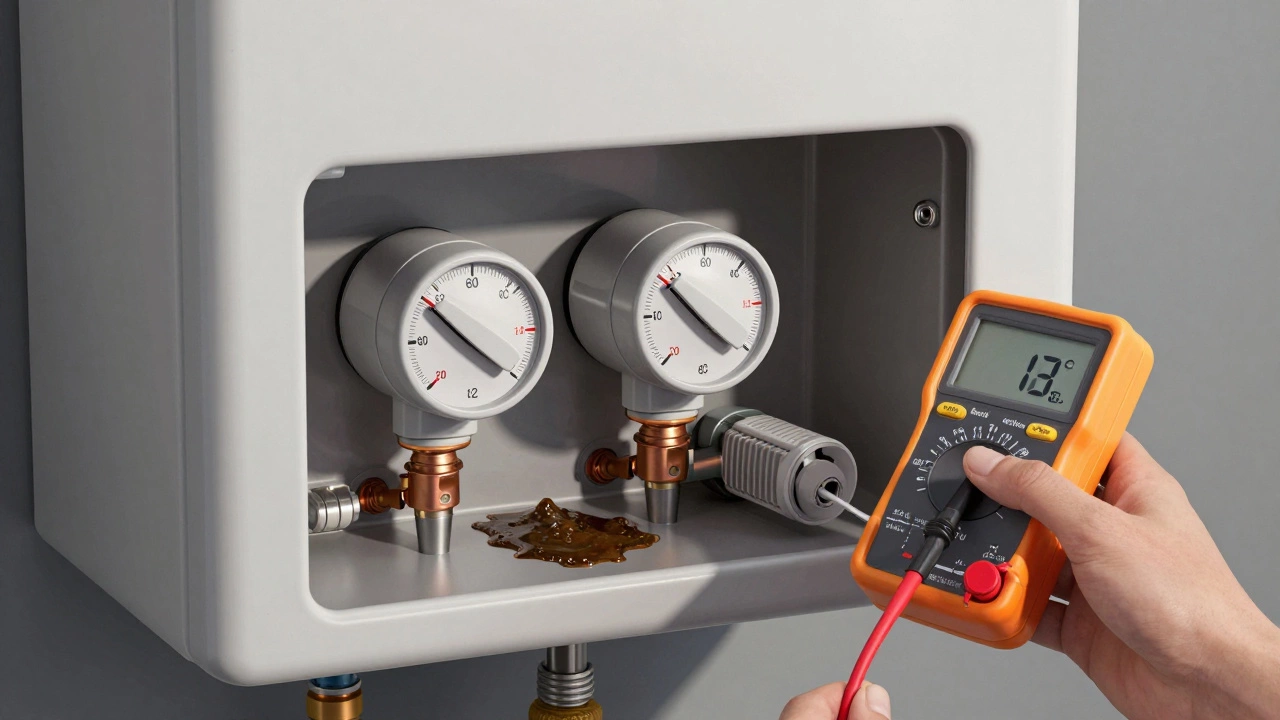
If power and thermostats check out, the heating elements might be dead. This is common in areas with hard water like Brisbane, where mineral buildup slowly kills the elements. You’ll need a multimeter to test them.
Turn off the power. Drain a few liters of water to lower the level below the elements. Remove the access panels and insulation. Disconnect the wires from each element (label them). Set your multimeter to ohms (Ω). Touch the probes to the two terminals on the element. A reading between 10-16 ohms means it’s good. No reading or infinite resistance? The element is dead. Replace it. Most 240V elements cost under $50 and are easy to swap with basic tools.
5. Check the Gas Supply and Pilot Light (Gas Units)
Gas water heaters rely on a pilot light or electronic ignition. If the pilot went out, you won’t get heat. Look for a small window on the front of the unit. If you don’t see a blue flame, the pilot is out. Follow the lighting instructions printed on the tank. Usually, you turn the gas knob to "Pilot," press it down, hold a lighter to the pilot tube, and wait 30 seconds before releasing. If it won’t stay lit, the thermocouple might be faulty.
The thermocouple is a thin metal rod that senses the flame. If it’s dirty, bent, or worn out, it shuts off the gas. Clean it with fine sandpaper. If that doesn’t work, replace it-it’s a $20 part and takes 15 minutes. Also, check your gas meter. Is it turned on? Is there a leak? If you smell gas, turn off the main valve and call a professional immediately.
6. Look for Leaks or Corrosion
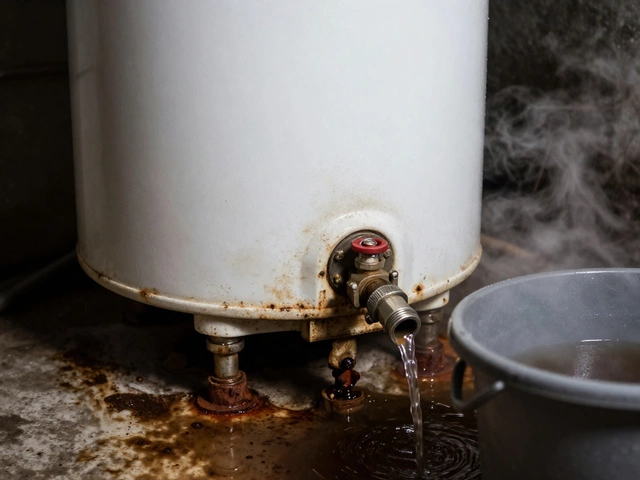
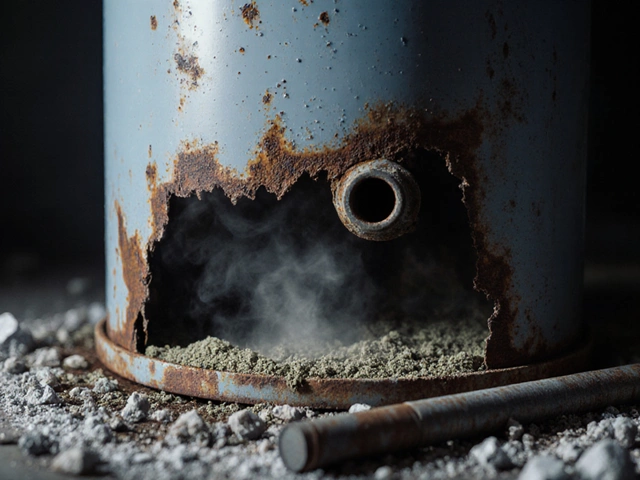
Water heater tanks don’t last forever. Most last 8-12 years. If your unit is older than 10 years and you’ve got water pooling around the base, that’s a red flag. Corrosion inside the tank can cause pinhole leaks. Even a small leak means the tank is failing. No amount of fixing will save it.
Check the pressure relief valve too. If it’s dripping constantly, it could mean excessive pressure or a faulty valve. Test it by lifting the lever-it should release a strong stream of water. If it doesn’t, or if it leaks after you let go, replace it. A bad valve can cause dangerous pressure buildup.
7. Flush the Tank for Sediment Buildup
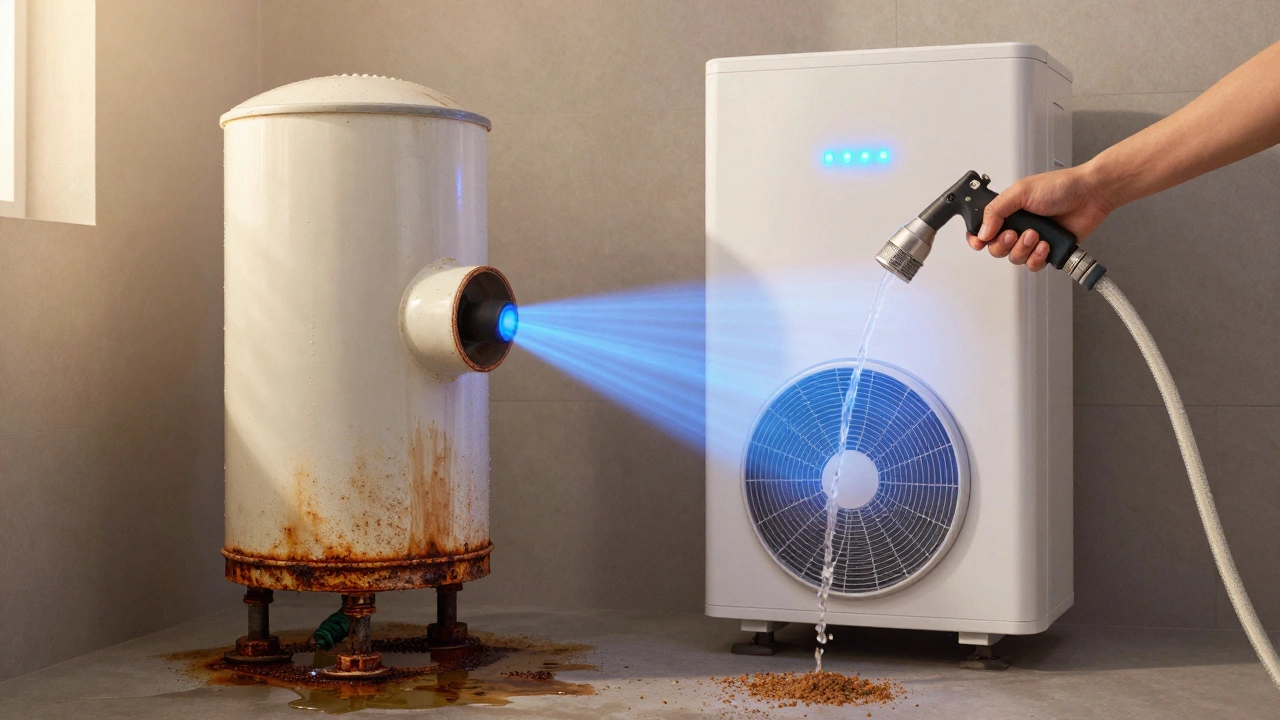
Sediment from hard water sinks to the bottom of the tank. Over time, it forms a thick layer that insulates the heating element from the water. The element works harder, overheats, and burns out. You might hear popping or rumbling noises before it fails.
Flush the tank every 6-12 months. Turn off the power or gas. Close the cold water inlet. Attach a garden hose to the drain valve at the bottom. Open the valve and let water flow into a drain or yard. Let it run until the water runs clear. This alone fixes 30% of "no hot water" complaints in older homes.
8. Consider the Age of the Unit
If your water heater is over 12 years old, you’re in replacement territory. Even if you fix one part, another will fail soon. New units are 20-30% more efficient. Modern electric models have better insulation and smarter controls. Gas units now come with condensing technology that saves money on bills.
In Brisbane, where winters are mild but water usage is high year-round, upgrading to a heat pump water heater can cut your energy costs by up to 70%. They’re not cheap upfront, but rebates are available through the Queensland government. If your heater is old and broken, replacing it now saves you from a bigger mess later.
What Not to Do
Don’t try to repair a gas valve yourself unless you’re trained. Gas leaks are dangerous. Don’t ignore rust or leaks-waiting makes it worse. Don’t assume the problem is electrical if you have a gas unit. And never turn up the thermostat to max hoping for faster heat-that just wears out the system.
When to Call a Professional
Call a licensed plumber or electrician if:
- You smell gas
- The pressure relief valve won’t stop leaking
- You’ve tried resetting everything and still have no hot water
- Your unit is over 10 years old and shows signs of corrosion
- You’re uncomfortable working with electricity or gas
Most repairs take less than an hour. A professional can diagnose the issue in 15 minutes and give you a quote before starting work. Don’t risk your safety or make the problem worse by guessing.
Why does my hot water heater make loud popping noises?
Popping or rumbling sounds are caused by sediment buildup at the bottom of the tank. When water gets trapped under the layer of minerals, it heats up and boils, creating steam bubbles that burst loudly. Flushing the tank usually fixes this. If the noise returns quickly, your water is too hard-consider installing a water softener.
Can I replace a water heater element myself?
Yes, if you’re comfortable with basic tools and electricity. Turn off the power, drain the tank, disconnect the wires, and remove the old element. Install the new one, reconnect the wires, refill the tank, then turn the power back on. Always match the wattage and voltage of the original element. Most hardware stores sell the right parts for your model.
How often should I flush my water heater?
Flush it at least once a year. In areas with hard water like Brisbane, do it every 6 months. Hard water leaves behind calcium and magnesium that settle in the tank. Over time, this reduces efficiency, shortens lifespan, and can cause element failure. Regular flushing is the cheapest maintenance you can do.
Is it worth repairing an old water heater?
If your heater is over 10 years old, repairs are usually a waste of money. Even if you fix one part, another will fail soon. New units are more efficient, come with 6-12 year warranties, and often qualify for government rebates. In Queensland, switching to a heat pump or solar water heater can cut your energy bill by half. Paying for a new unit now saves you more than fixing the old one.
Why do I only get hot water for a few minutes?
This usually means the top heating element is working but the bottom one isn’t. Electric tanks heat water in layers. If the bottom element is dead, you only get the small amount of hot water stored at the top. Once that’s used up, it’s cold. Testing and replacing the bottom element fixes this. Gas units with this issue may have a faulty dip tube or burner assembly.